

Security cameras outside homes and apartments raise a lot of questions – especially when it comes to what’s fair, what’s legal, and what crosses the line.
They can make a property safer, but they can also feel invasive if used without care.
So where exactly is that line between security and privacy? We’ll break down what landlords can and can’t do when it comes to outdoor cameras.
Key Notes
- Landlords can legally install cameras in parking lots, entrances, and shared hallways.
- Cameras aimed at private balconies, unit interiors, or recording audio violate privacy laws.
- State laws vary widely; New York prohibits any filming into a tenant’s private space.
- Hidden cameras are illegal everywhere, regardless of location or landlord intent.
Understanding The Basics
Whether you rent or own, security cameras outside a home can feel like a gray area.
For landlords, they’re a tool for protection – helping prevent break-ins or vandalism. For tenants, they can feel intrusive if placed without notice or aimed at the wrong spot.
To find the line between safety and privacy, it helps to understand how the law draws it:
At the heart of it all is the idea of reasonable expectation of privacy. This is what courts use to decide if surveillance crosses into illegal territory.
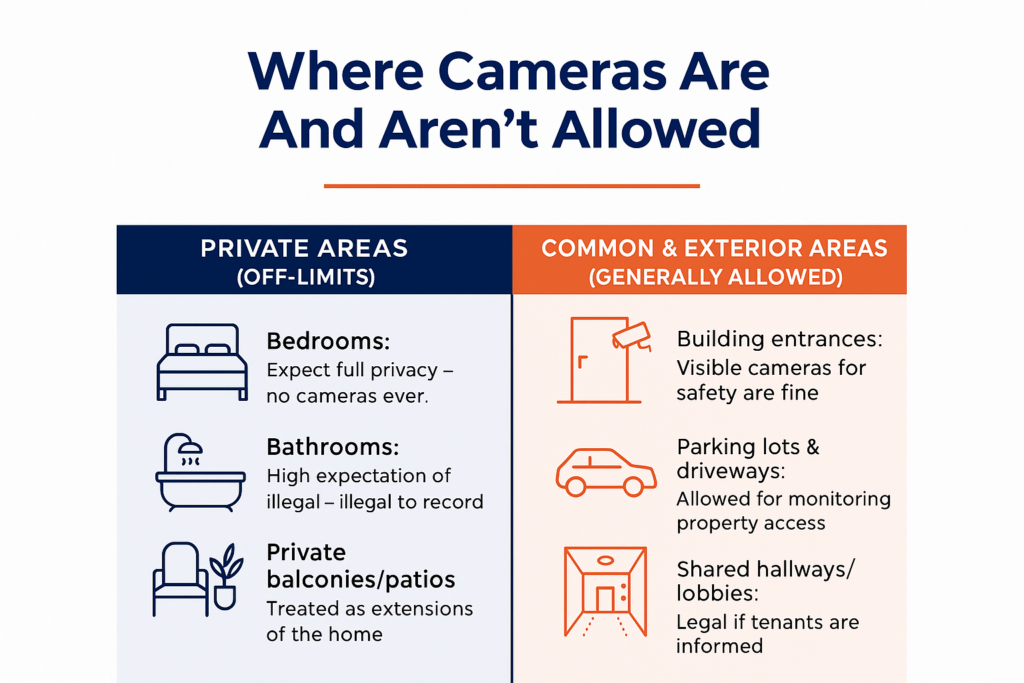
In plain terms, if a space is somewhere people expect to be left alone – like a bedroom, bathroom, or private balcony – it’s off-limits for cameras.
But in open, shared, or exterior areas where activity is visible to others, cameras are usually fair game.
The Core Legal Principles
Most US laws agree on a few fundamentals:
- Video is usually fine in public or shared spaces. Think parking lots, entryways, and hallways. These aren’t places where tenants expect total privacy.
- Audio is another story. Recording conversations can violate wiretap laws if you don’t have the right kind of consent. Some states only need one person’s consent; others require everyone’s.
- Hidden cameras are never okay. Secretly filming tenants in any context – especially inside or through windows – is illegal and considered voyeurism.
- Transparency goes a long way. Visible cameras, clear signage, and written notice not only reduce legal risk but also build trust with tenants.
Put simply, if you’re a landlord installing cameras, always ask:
Would a reasonable person expect privacy here?
If the answer’s yes, that spot’s off-limits.
Federal Law: The Foundation
Federal law doesn’t directly say where landlords can place cameras, but it does set the tone for privacy and recording ethics.
The Federal Wiretap Act and the Electronic Communications Privacy Act (ECPA) make it illegal to intercept or record private communications without proper consent. That means if a security camera records audio, you could be breaching federal law unless everyone being recorded agrees.
There’s also the Fair Housing Act, which prohibits using surveillance to harass or discriminate against tenants. So, even if a camera’s location seems legal, its use or intent can still land a landlord in trouble.
Federal laws are the starting point. The real rules, however, come from state and local laws.
How State and Local Laws Differ
State laws vary widely when it comes to surveillance.
Some, like California and Florida, are strict – requiring consent for all recorded audio and banning video in nearly all private areas. Others, like Texas, are more lenient but still draw clear lines around hidden or intrusive cameras.
New York sits somewhere in the middle. It allows video surveillance in common or exterior areas, provided the cameras are visible, disclosed, and used for legitimate safety reasons.
But it takes a hard line on private spaces: under NY Penal Law §250.45, filming inside any area where a tenant has a reasonable expectation of privacy (like their living room) is a criminal offense.
The takeaway: Always check local regulations, because what’s allowed in one state could be a felony in another.
Where Cameras Are Allowed & Where They Aren’t
Here’s how different locations are generally treated:
| Area | Legal Status | What to Know |
|---|---|---|
| Building exterior (parking lots, entrances) | ✅ Allowed | Visible cameras for safety are fine; avoid pointing them into windows. |
| Common areas (hallways, mailrooms, lobbies) | ✅ Allowed | Permitted if tenants are notified and cameras are visible. |
| Individual unit doors | ⚠️ Risky | Avoid targeting a specific door – it can be seen as harassment. |
| Private patios or balconies | ❌ Not allowed | Treated as part of a tenant’s private space; off-limits without consent. |
| Inside rental units | ❌ Illegal | Prohibited under federal and state privacy laws. |
New York’s Specific Rules
In New York, landlords can absolutely install cameras for security, but the placement and intent must be reasonable.
- Cameras in common or outdoor areas (entrances, lobbies, parking lots) are fine if tenants are aware and footage is used strictly for security.
- Cameras inside private quarters, even partially visible ones aimed into a unit window, are strictly prohibited and can lead to felony charges.
- Hidden cameras are never allowed, regardless of where they’re placed.
- Footage can’t be shared, streamed, or used for personal purposes – only for legitimate safety or property management reasons.
Best practice in New York is to include camera policies in the lease, post signage at building entrances, and provide written notice if cameras are added later.
Notice and Transparency: The Best Way to Avoid Trouble
The right approach to surveillance depends on the kind of property you manage.
Single-Family Homes
Landlords can usually install exterior cameras aimed at shared access points, driveways, or yards, but not into the tenant’s private interior or exclusive outdoor areas.
Even on a small property, it’s easy for cameras to cross into privacy territory if they’re positioned poorly.
Multi-Family or Apartment Buildings
These have more shared areas and more potential for problems.
Cameras in hallways, lobbies, and garages are fine when visible and properly disclosed. But angles that single out individual doors or windows are a privacy risk.
Buildings with multiple tenants should also have written surveillance policies and retention rules.
Mixed-Use or Commercial Properties
For these, security cameras often integrate with access control or intercom systems.
The same principles apply: focus on safety, not surveillance. Audio should still stay off, and tenants should know what’s being monitored.
Property Type Matters
Even where it’s not legally required, notice is the smartest move a landlord can make. Written communication and clear signage help establish trust and prevent misunderstandings.
A good notice should include:
- The purpose of the cameras (security, not surveillance of individuals)
- General locations of cameras (without disclosing exact blind spots)
- Confirmation that audio recording is disabled
- How long footage is stored and who can access it
And signage should be direct and easy to spot. Something as simple as: Security Notice: Video surveillance in use for property protection. No audio recording.
A small step, but it goes a long way toward transparency and compliance.
When to Call a Professional
If you’re unsure whether your camera setup complies with privacy laws, or if your building’s layout makes placement tricky, it’s worth getting professional guidance.
A security expert can help you:
- Identify legal sightlines and blind spots
- Configure cameras with privacy masks and proper retention settings
- Disable unnecessary audio features
- Create signage and documentation that satisfy legal and ethical standards
Worried About Privacy & Legal Risks?
Frequently Asked Questions
Can landlords use security cameras that send live feeds to their phones?
Yes, but only for common or exterior areas where tenants don’t have a reasonable expectation of privacy. Live feeds can’t be used to monitor individual tenants or private behavior.
Are landlords allowed to share surveillance footage with other tenants?
No. Footage should only be shared for legitimate safety or property management reasons, such as reporting vandalism or theft – never for curiosity or gossip.
What happens if a landlord refuses to remove an intrusive camera?
Tenants can document the issue, file a written complaint, and contact local housing authorities or legal counsel. Courts can order cameras to be removed if they invade privacy.
Can a landlord require tenants to install their own cameras?
Generally, no. Tenants can choose to install personal cameras inside their unit, but landlords can’t mandate it or require them to share footage unless clearly outlined in a lease.
Conclusion
When it comes to outdoor security cameras, the line between protection and privacy depends on visibility, intent, and consent.
Landlords are within their rights to install visible, video-only cameras in exterior or shared areas, as long as tenants are informed and the footage is used strictly for safety.
But the moment cameras capture private interiors, exclusive balconies, or audio without consent, they cross from legal to unlawful.
If you want to secure your property the right way – with smart placement, privacy-safe configurations, and clear compliance – book a free appointment with us today.